
800v vs 400v EVs...does it really matter?
Headline EV charging power specs are misleading and 800v vs 400v really matters.

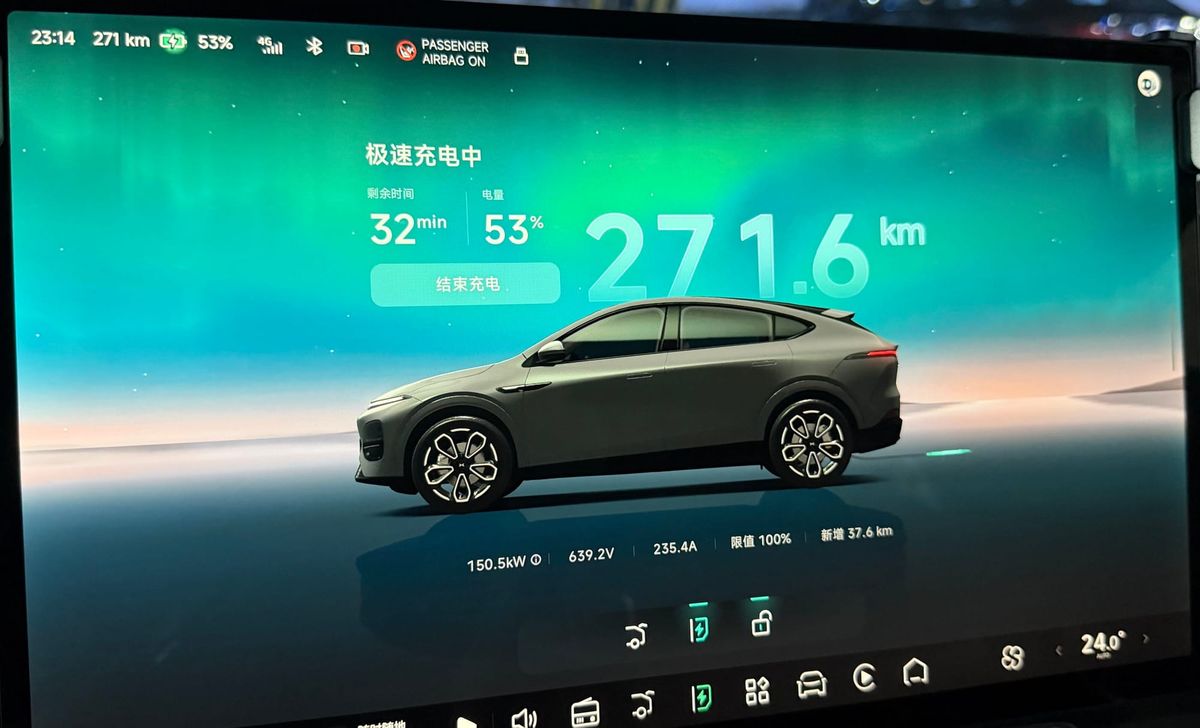
EV and charging infrastructure manufacturers like to list the maximum charging rate the vehicle will accept or the charger will put out, but in the wild, it is very difficult to hit those numbers.
Why is that?
Let's take a look at what determines charging rate. There are actually three things that need to for a car to charge at its maximum rate:
1) the battery needs to be in such a condition that it can accept the max charging rate...this is some combination of having the correct state of charge, temperature and other conditions.
2) the charger need to be able to provide a high enough voltage
3) the charger needs to be able to deliver that voltage at a high-enough amperage
Battery conditions are something that the driver of the vehicle has control over, so this post will examine the other two.
I'll use my experience with the Xpeng g6 in and around Hong Kong as an example. The Xpeng g6, has a 800v charging system and claims to be able to charge at up to 451 kw...10-90% in 12 minutes.
In reality, I've never found a charger in Hong Kong or mainland China that both has a CCS2 plug that works with my vehicle AND can charge at a voltage of more than about 650v. Even Xpeng's self-branded charger in Hong Kong won't actually charge at 800v. I've also never found a charger that will deliver more than 400 amps at any voltage. Because of this, the max charging rate I've hit in the wild is only about 400 amps x 600v... roughly ~240 kw.
If you're going to have trouble finding DC fast chargers that can max out your charging rate anyways, then it doesn't really matter if your car has an older, slower 400v system instead of a 800v, right?
Wrong. An EV with a 800v system will still usually charge faster than an EV with a 400v system even if the charger won't max out either car's charging capabilities. I started noticing this when I was charging next a Hong Kong-registered Tesla capable of charging at 250 kw in Zhuhai at chargers that maxed out at 150 kw.
I pulled up next the Tesla that was already in the process of charging, completely charged my Xpeng and left while the Tesla was still parked there charging. Why was my Xpeng charging so much faster than the Tesla on a charger that was far from maxing out either car's capabilities? What exactly was going on?
In this location, the chargers only put out a max of 250 amps and ~600v which meant I was only able to charge at 150 kw. The Tesla was also subject to the same 250 amp limit, but also due to its 400v architecture, it also self-imposed a 400v limit. This meant that at 250 amps it could only charge at around 96 kw...much less than its headline max charging power capability and materially slower than 800v architecture Xpeng.
There are two ways to increase the amount of power delivered by a charging...increasing the voltage or increasing the amperage. When one of the two properties reach their limit, the only option to further increase power is to increase the other property.
In our example, the Xpeng's 800v architecture was able to take the maximum amount of both voltage and amperage that the charger could deliver. The Tesla, in contrast, with its 400v architecture was only able to accept the maximum amperage the charger could deliver but unable to accept the maximum voltage the charger offered.
Even though neither the 800v nor 400v vehicles in our example got remotely close to maxing out their headline charging capability, the 800v vehicle still significantly out performed the 400v vehicle. So, yes, I'd 800v vs 400v does matter.