
Ben Thompson is wrong: US frontier labs are right to be panicking

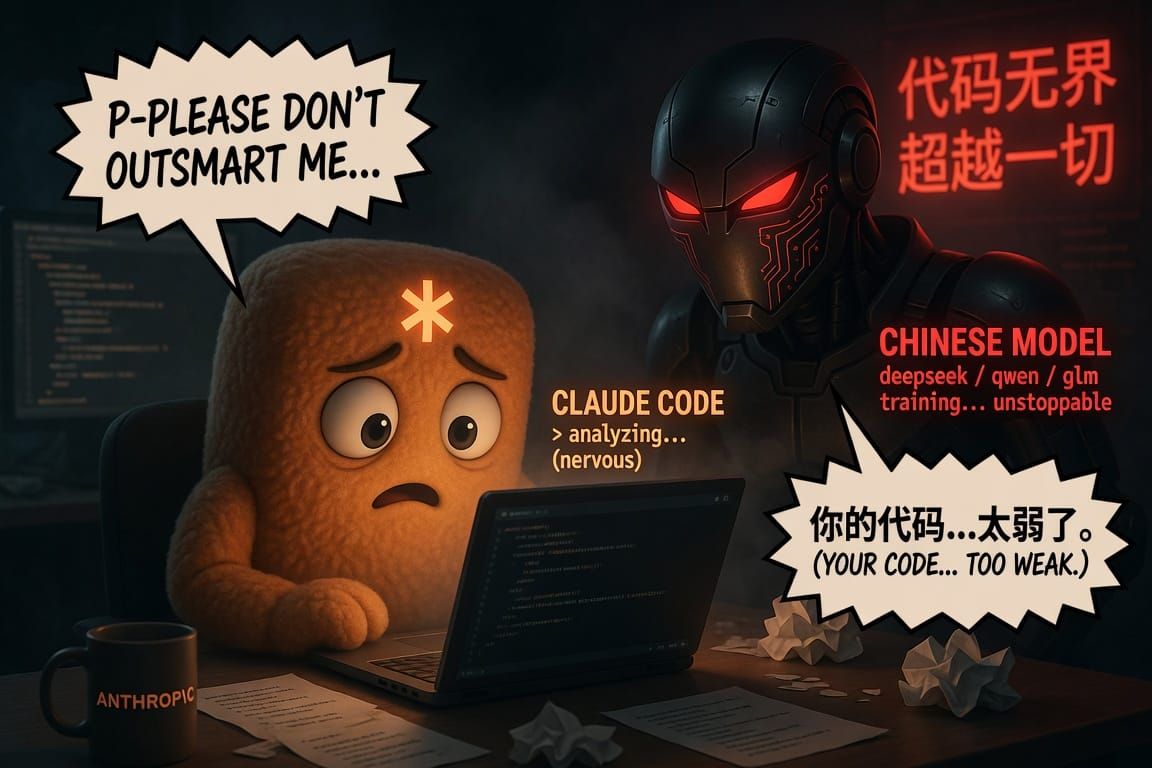
American tech blogger Ben Thompson writes today that US frontier labs should not be panicking about Chinese open source models like Kimi K3, despite them being competitive with the best models from American labs. We can "distill" (ha!) his post down to two main arguments:
Anthropic and OpenAI likely have among the lowest costs per unit of frontier-quality intelligence, thanks to model capability, serving scale, and token efficiency.
The first is that US frontier labs are "likely" the cheapest providers of inference and, because of that, what they lose in pricing power due to Chinese model competition, they can make up in volume.
It’s striking the extent to which Claude Code and Codex are proving to be quite sticky; whichever harness you start working with is likely to be the one you stick with, and that figures to be even more the case with non-technical users.
The second is that US frontier labs now own, and will continue to own, the user relationships because of the "stickiness" of their tools.
Thompson is wrong on both points.
Unit costs
Let's examine his first point about supposedly low US frontier labs unit costs. While US frontier labs likely have more chips than Chinese labs, everything else in their token supply chain: electricity, data center construction costs, etc, cost significantly more than the equivalent commodities in China today. And this is before Huawei's latest chips are shipping in volume.
Today, all Chinese unit cost inputs except chips are cheaper, so how likely is it that the US frontier labs have the lowest unit costs today? And as alternatives to US chips come online, like Huawei's latest chips, increasing market supply, how likely will it be that US frontier labs have the lowest unit costs in the future?
Stickiness
His second point, that tool stickiness will save US frontier labs is unconvincing to anyone who has actually been using AI instead of just writing about it. Take the examples he gives: "Claude Code" and "Codex." As any reader of Hacker News will tell you, Claude Code is already yesterday....in fact, it's last week. Yesterday was Codex, and Cursor is ancient history. Today, all the cool kids are using Opencode, which makes it trivial to switch between models and inference providers. But even when developers were still using Claude Code, they quickly figured out unapproved ways (often with Claude's help) use Anthropic's app with non-Anthropic, 3rd party models and inference providers. And often you couldn't even tell the difference.
And if this wasn't convincing enough: right now, literally as I write this, there's an article on the front page of Hacker News with over 200 comments telling us why we should all stop using Opencode with dozens of comments pitching Opencode alternatives. I've never heard of most of the suggestions, but I would be entirely unsurprised if one of them turns out to be the hottest, must-use tool that absolutely everyone in the developer community is using tomorrow.
The situation is the same with non-technical users who are seriously using AI. Today, they're using Claude Cowork but yesterday they were all using Manus. And before that, they were using Perplexity. These are professionals or prosumers trying to get an edge in their jobs or in their lives, they're willing to spend money and they jump ship as soon as something slightly better appears.
Sure, the mass market consumer user who asks "AI" a question a few times a week might have downloaded ChatGPT or Doubao when they first heard of AI and never switched to anything else. But those users usually don't pay much if anything at all and will hardly bail the labs out of their sinking ships.
Tool stickiness will save US frontier labs. Right.
US frontier labs are structurally screwed
Investors invested ungodly amounts of money in these labs because they told them they have some secret sauce and it turns out that the secret sauce was just ketchup. Everyone, even Chinese food delivery apps have the LLM ketchup. Not only do US frontier labs not have any secret sauce, they're building businesses where the largest input in their unit production is electricity in a country that has for decades been unable to build more electricity production. These US labs made massive capital commitments based on the assumption of future levels of profit that aren't ever going to come. And that's before you really dig down into the leveraged, financial house of cards they've built for themselves.
US frontier labs are right to be scared. And what do US businesses do when they're scared? Lobby for a government bailout.
I'm going to go out on a limb here (okay it's not a limb...it's more of bridge...a strong Chinese-made bridge, not one of those American ones that gets knocked down and never rebuilt) make three predictions:
- US frontier labs will not be saved by their unit costs or tool stickiness.
- US frontier labs will not be "frontier" for much longer.
- China will become the inference capital of the world: the highest quality, largest quantity and least expensive producer of tokens. This will happen over the next few years either in the absence of government regulations preventing US companies from using Chinese inference providers, or in spite of them.
Let's watch.