
The old days of counterfeit currency in China

China didn't always used to be the high-trust, safe society that it is today. I have many stories and anecdotes about all the low-trust society things that happened 15 to 25 years ago. Since I'm writing every day, I might as well turn it into a series. Here we go:
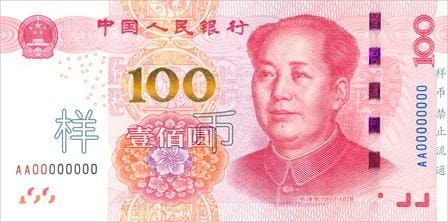
China used to be a largely cash-based society. As a low-trust, cash-based society, counterfeit currency was a real problem. You had to be on a constant lookout for fake renminbi. As a new visitor to China in 2002, you noticed that this was a problem pretty quickly by how people responded when you tried to spend the largest bank note, the red 100 CNY. This note was worth about 12 US Dollars at the time and was what ATMs in the mainland spit out, if you could find one that accepted your foreign-issued card. (hint: Bank of China ATMs were the most reliable for accepting foreign-issued bank cards!).
When you paid with a 100 CNY note, people treated it as if you were paying with a 100 USD note in the 1990s or a 1000 HKD or 1000 euro note. It was a lot of money. A merchant would always verify that your 100 CNY was in fact real. The first step was to make sure that the note wasn't made out of cheap Xerox paper. People accepting money would test this by grasping it along the long edges and moving it back-and-forth. Think of this motion as something like the motion you might use when trying to get a stain out of a piece of clothing. Fake money would usually rip in half, while real money would not. Next, you'd rub your thumbs over Chairman Mao's shirt to feel if there was a raised pattern. Fake money wouldn't have this. If all of this passed, you'd hold the bill up to light to look for the Chairman Mao watermark in the white area at the left of the bill and the watermark of the amount next to the printed amount in the lower left.
Normal people usually stopped here, but if you were a sophisticated merchant or in a high-risk industry, you might continue by shining a UV light on the bill or running it through one of the "magic" counterfeit currency detecting money counting machines.
For visitors who typically got their currency from a bank ATM, encountering counterfit 100s in the wild was pretty rare. Instead, you'd usually find yourself a victim of an unsavory merchant giving you change in 50s, 10s or 20s that were counterfeit. Most of the time, you wouldn't even notice that you had been given counterfeit change until sometime later when another merchant refused to accept it.
There was once though, an overseas Chinese friend of mine managed to get his perfectly real 100 CNY bills turned into counterfeit 100 CNY bills. He tried buying tickets for a sold-out performance from a ticket scalper on a dimly lit street. He handed over several 100 CNY bills to the scalper only for the scalper to say that he couldn't accept some of the bills for whatever reason. Keep in mind, it was common at the time for merchants to reject certain bills that weren't actually counterfeit just because they weren't entirely sure they were real. My friend took the money back from the scalper and gave him a different set of 100 CNY bills. Unbeknownst to my friend, the scalper hadn't returned the same bills that my friend had given him, but he had swapped them for counterfeit bills and return those to my friend. We'd essentially paid twice for the same tickets and received the tickets and some counterfeit money in exchange for our overpayment.
Since Chinese society of 20 years ago was low trust, what often happened to counterfeit money was that the people who had unknowingly received it tried to pass it off to other unsuspecting people instead of taking the loss themselves. Because of this dynamic, you really had to be on the lookout unless you wanted to be taken advantage of.
Counterfeit Chinese money was so common and checking for it was so culturally ingrained a few decades ago that I even chose the topic for a show-and-tell demonstration in Chinese class in Beijing back in 2003.
Thankfully, the days of counterfeit Chinese currency are now largely gone. Whether this is because China is now a high-trust society (which it largely is) or simply because most payments moved to electronic methods doesn't really matter because no who wasn't a currency counterfeiter misses them!