
Crossing the street in one country, two systems

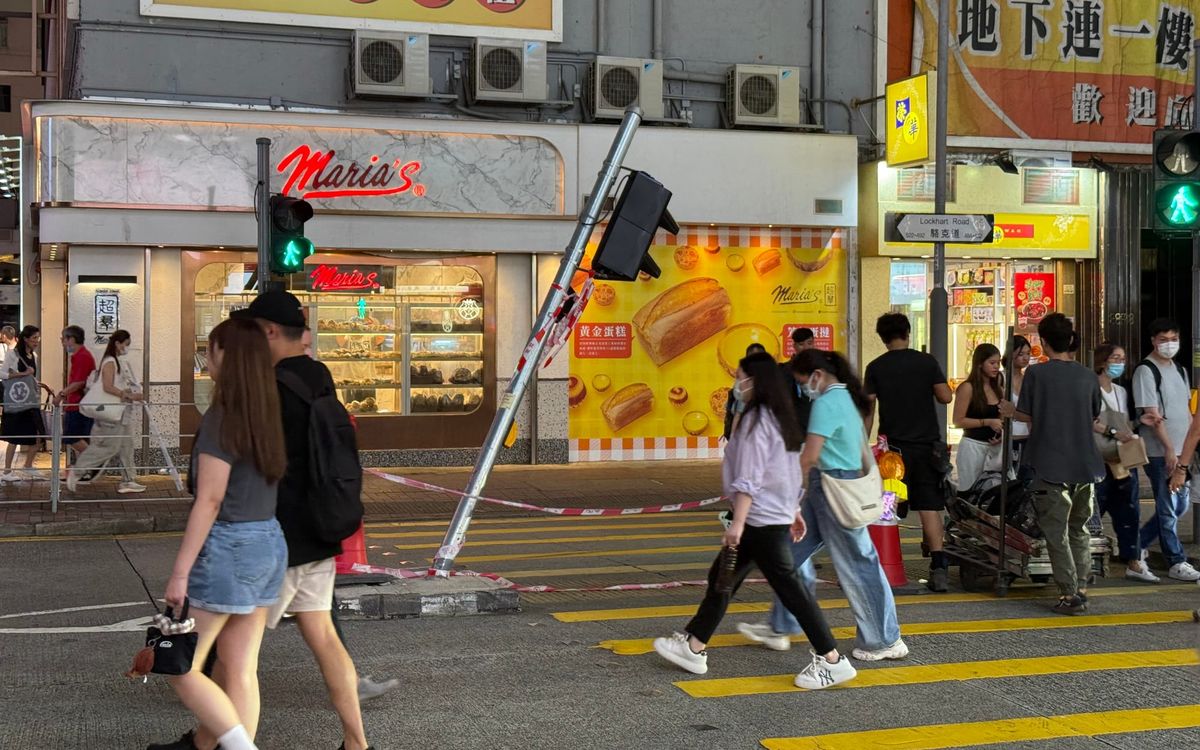
In case you haven't been following along, I'm in Macau for a few days. Macau was handed back to China 27 years ago in 1999...two years after China resumed sovereignty over Hong Kong in 1997. One would think that over three decades that behavior would have converged among the three places given the large cross-boundary migration and tourist flows, but, despite some media reports to the contrary, this is largely not the case. Take the simple example of crossing the street as a pedestrian. The experience is extremely different in Hong Kong, Macau and the Chinese mainland.
Drivers in Macau are by far the most courteous to pedestrians. They slow down for pedestrians even if the pedestrians are still several meters from entering crosswalks. Drivers' behavior feels very much like ones from Western Europe or New England in their attitude towards pedestrians. This is been especially noticeable and appreciated on my current trip while pushing a stroller around the former Portuguese colony on our first vacation with our baby.
Contrast this with Hong Kong, where drivers will almost never yield to pedestrians even in a marked zebra crossing where they are legally obligated to yield. If a Hong Kong driver notices a pedestrian approaching a crosswalk (and that's a big "if"!), he will often speed up to get through crosswalk before the pedestrian can step on to the street. Hong Kong drivers are very much like Hongkongers in elevators that furiously mash the door close button so that the door closes before people running towards the lift can enter it. (I embarrassingly must admit to sometimes practicing this behavior myself!)
Because of this aggressive driver behavior in Hong Kong, pedestrians have been trained to yield to vehicles even when they have a right-of-way out of a healthy sense of self-preservation. As a driver, it's difficult to change this culture of bad-behavior towards pedestrians, because when one does actually try to politely yield to pedestrians, the pedestrians often either 1) are totally shocked and stand there in stunned disbelief, unable to actually move or 2) not paying attention anyways and looking at their phones until they sense that all cars have moved out of the vicinity. What ensues is a time-consuming dance where the yielding driver determines that pedestrian doesn't actually intend to cross the street and starts to proceed just as the pedestrian finally gets over the shock of a Hong Kong driver yielding to them and takes a step towards crossing the street. No one gets anywhere and the honking that ensues from impatient drivers in traffic teaches the yielding driver that yielding to pedestrians in Hong Kong is an exercise in futility.
Moving on to the Chinese mainland, we find that the road crossing experience for pedestrians varies much more by city. Historically (greater than 10 or 15 years ago), drivers across the Chinese mainland rarely yielded to pedestrians. That changed at some point in many more developed cities such as Shenzhen thanks to camera enforcement and fines. Today, a city like Shenzhen sits somewhere on the spectrum between Macau and Hong Kong concerning courtesy toward pedestrians with it landing somewhat closer to Macau. In cities like Shenzhen, 礼让行人 (courteously yield to pedestrians) cameras surround many crosswalks looking out for violators while navigation apps warn drivers to watch out. This results in drivers that, more often than not, yield to pedestrians at crosswalks but in a way that feels much more involuntary and mechanical. It is as if they are yielding because the satnav told them to and out of fear of a fine instead of out of a genuine desire to be courteous to pedestrians. And some drivers will still roll through a crosswalk with pedestrians, albeit much more slowly than a Hong Kong driver would, if they suspect there are no cameras and nobody watching.
The lesson here is that, in the absence of a coordinated effort or change in incentive structure, old habits are hard to change.